
Guwahati emerging as a key centre linking cities across Southeast Asia: Secretary, Act East Policy Affairs Department
RGU holds Youth Interaction on Act East Policy and Assam’s Emerging Role
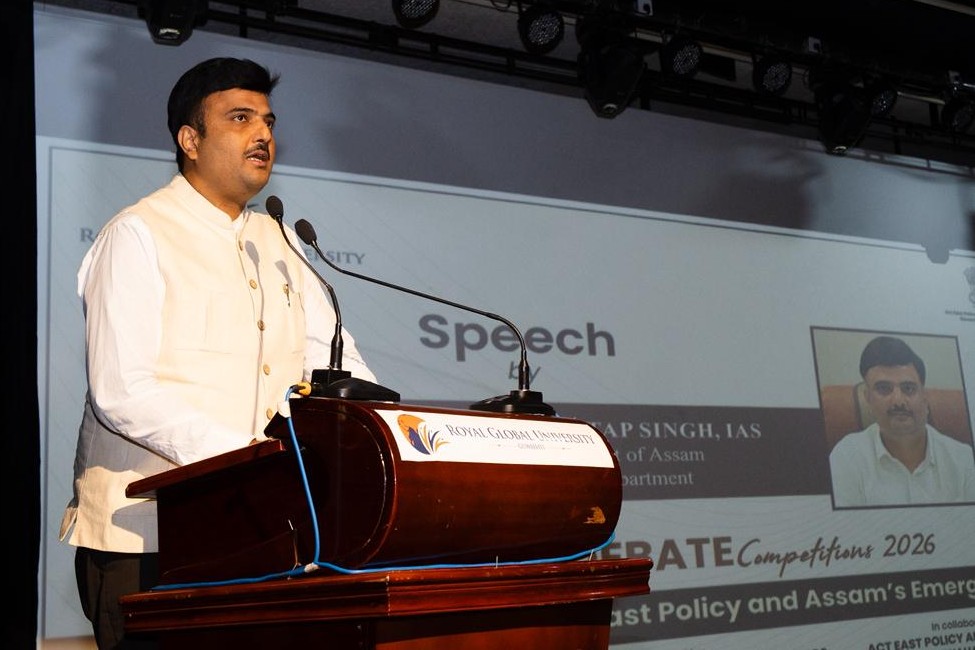

GUWAHATI, March 10, 2026: The Assam Royal Global University (RGU) has held a
Quiz and a Debate Competition on “Youth Interaction on Act East Policy and Assam’s Emerging Role” here
today. The event was organised by the Department of Economics and the Internal Quality Assurance Cell
(IQAC), RGU, in collaboration with the Act East Policy Affairs Department, Government of Assam. The
programme brought together students from colleges across Assam, and officials from the Act East Policy
Affairs Department for a meaningful exchange of ideas on the growing strategic significance of Assam and the
Northeast in India’s foreign policy framework.
Delivering the keynote address, Shri Rajiv Bora, IAS (Retd.), former Additional Chief Secretary of Assam and
APSC Chairman, reflected on the relevance of the Act East Policy in the contemporary global context.
Emphasising that the Act East Policy is a crucial pillar of the Government of India’s foreign policy, he
highlighted the Northeast’s geographical and strategic position as a natural bridge between India and
Southeast Asia.
Shri Bora observed that the region, endowed with abundant natural and cultural resources, can serve as the
fulcrum of India’s engagement with neighbouring countries under the Act East Policy. However, he cautioned
that the effective implementation of the policy depends largely on achieving a minimum threshold of
development in the Northeast, particularly in terms of infrastructure. He also stressed the importance of
enhancing people-to-people contacts and cultural exchanges with neighbouring countries to strengthen
regional cooperation.
Shri Manavendra Pratap Singh, IAS, Secretary to the Government of Assam, Act East Policy Affairs Department,
spoke about the government’s efforts to leverage the Act East Policy for the socio-economic transformation
of the region. He pointed out that many cultural practices in Northeast India have historical connections
with Southeast Asia, illustrating long-standing civilisational linkages.
He further highlighted major developments that could strengthen Assam’s global connectivity, including the
anticipated growth of Lokpriya Gopinath Bordoloi International Airport in Guwahati as a major regional hub
in the coming years. Referring to the upcoming semiconductor project at Jagiroad, he said such initiatives
would open new economic opportunities and place Assam more prominently on the global map. He also envisioned
Guwahati emerging as a key centre linking cities across Southeast Asia.
Shri Sazzad Alam, ACS, Additional Secretary to the Government of Assam, Act East Policy Affairs Department
conducted the quiz competition as part of the programme, which witnessed enthusiastic participation. The
topic for the debate competition was, “Assam can become India's Logistics Hub for Southeast Asian trade
under the Act East Policy”.
Earlier in the inaugural session, Prof Shiela Bora delivered the welcome address, noting that the spirit of
the Act East Policy is not entirely new to the Northeast. She observed that the region historically
maintained vibrant trade and cultural exchanges across borders since ancient times.
Addressing the gathering, Prof A.K. Buragohain, Vice Chancellor of RGU, emphasised that universities play a
vital role in facilitating such engagements. He remarked that academic research and intellectual discourse
can significantly contribute to the effective understanding and implementation of important national
policies such as the Act East Policy.
Prof Dhrubajyoti Borah, Advisor to the Chancellor and Author-in-Residence at RGU, spoke on the historical
significance of the Southern Silk Route, describing it as a vibrant trade corridor that once passed through
regions such as present-day Biswanath Chariali in Assam. He pointed out that these ancient routes were not
merely channels for trade in goods but also pathways for the exchange of ideas, cultures, and knowledge. The
programme concluded with a vote of thanks delivered by Prof Swabera Islam, Advisor to the Department of
Economics, RGU.